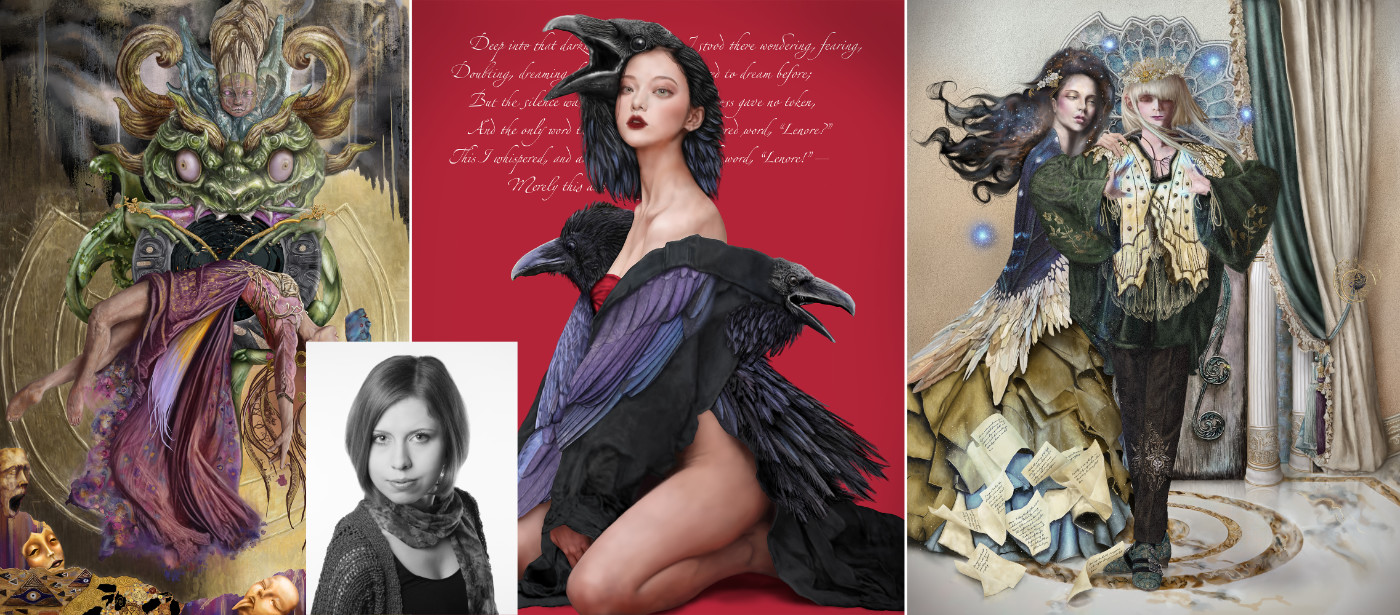
Ellie Nesbitt (FAYBEL) is an artist and illustrator based in Ontario, Canada. Her imaginative, fantastical, hyper-realist paintings are defined by lush narrative storytelling and intricate detail. Visual tales are sculpted from old world mythologies, cultural symbologies and folklore. Ellie’s collections have been published in renowned art books and magazines and she has shown her work at high-end galleries around the world. She has also written extensively on her gallery process for Hyperlux Magazine, and has assembled a cohort of award-winning digital painters to define elements of gallery practice for digital and to initiate a first digital illustrator’s exhibition of its kind.
FAYBEL is a unique artist in many ways – from her subject matter, to her style, to the fact that she’s a digital artist showing work in gallery exhibitions – but even more unique is the way she creates her work. Because of a major spinal injury a few years ago, she now creates her work in the supine position in bed, with the tablet against her chest! We wanted to speak with her about her background, her inspiration, the unique way she creates her work, what she has coming up in the future, and more. Note: the interview below has been edited for length and clarity.
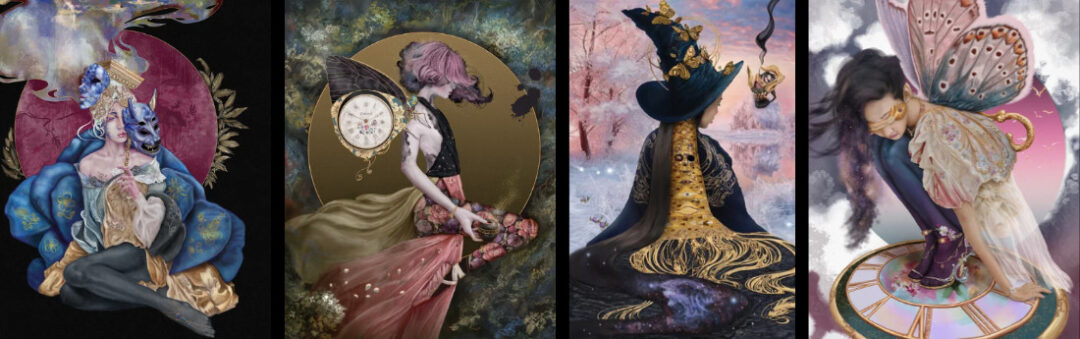
Many of your paintings have a fairytale quality and feel rich with story. How do you approach storytelling and narrative in your work?
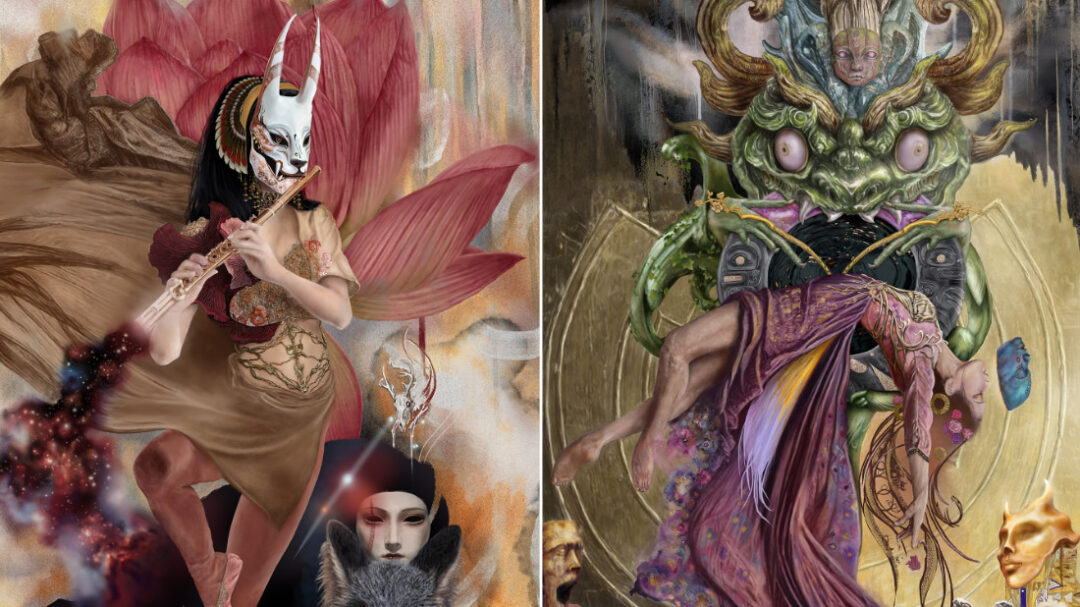
I am a voracious listener of romantasy audiobooks, a genre with delicious blend between dashing romance and high stakes fantasy. My grandmother, a life-long impassioned reader herself, would read me fairytale classics as a child from Peter Pan to The Water Babies by Charles Kingsley. I remember falling in love with Jessie Willcox Smith’s dreamy illustrations within our copy of both tales, as well as watching my grandmother paint in her basement art studio. As a child, I was a teller of dramatic tales, improvising stories of action and fantasy in a game I created for the neighborhood children called “Adventure,” which we played every day after primary school. This penchant for storytelling – past and present, literary and visual – weaves its way into each piece I create.
My artworks all tell two twin tales: one of my life in the moment, and a second with scenes and characters from fiction: either my fairytale universe Timbretock or a classic poem, mythology or fairytale blend. While I often begin each piece with a strong narrative concept, I allow my paintings’ stories to develop throughout the creation process naturally.
What kinds of stories or themes are you most drawn to in your art?
I studied Egyptology for a brief time at the University of Toronto, and have always been entranced by aspects of Norse mythology and media, films of gothic horror and monster romance masterfully accomplished by Guillermo del Toro, stop motion narratives from the mind of Tim Burton, classic poetry the likes of Edgar Allan Poe, and fairytales from across cultures and time. Stories I enjoy most are ones of truth, rebirth and perseverance through adversity. For example: Vasailisa’s persistence against the trials of Baba Yaga with the help of a magical doll, in the Russian Cinderella fairytale, Vasilisa the Beautiful, and the Little Mermaid’s resolution to remain on land for a dream of the future, in spite of each step feeling as if on sharp knives, in Hans Christian Anderson’s original fairytale classic. These are the brand of story that siphon my thoughts and senses, the ones that meld into the identity of my artworks and become a mirror to my own.
How did your journey as an artist begin?
My journey as an artist began in three parts: the first with my grandmother in her basement studio – the wonder I experienced watching her paint masterfully in acrylics, while I played pretend with paints of my own; the second, during a high school trip to western Europe, when I captured a derelict watermill with my family’s old Pentax point-and-shoot camera – which encouraged me to study photography for a time at Niagara College; and the third after over a decade of chronic and debilitating illness. After years of struggle with my health, I did not wish for the final stretch of my life to fizzle without being like my grandmother: a painter, but of my own voice and kind. I became obsessive, drawing digitally over 10 hours a day, migrating from mild paint-overs of video-game stills taken with in-game photo-modes to original portraiture works accomplished in Adobe Photoshop.
What first drew you to digital art, and what was your experience like transitioning from traditional to digital painting?
One of my major inspirations was seeing multi-disciplinary artist Bobby Chiu’s booth in Artist Alley at Fan Expo Toronto, brimming with digitally-created fantastical creatures. I couldn’t afford to buy a print of his, but I collected Imaginism’s business cards, each with a different creature artwork design.
Moving to digital painting from traditional graphite work was overwhelming. When I explored the possibilities of digital creation, it felt like there were far too many options. I studied masters of the medium and worked tirelessly to refine my technique. Self-reflection, time, and compromise with my perfectionistic tendencies – learning to create within my own self-governed technical limits – these were pivotal steps on my journey of style discovery and digital brush mastery.
You’ve built a career as a gallery artist working in the digital medium. What practical advice would you share with artists who hope to do the same?
My first piece of advice: do not delve into gallery work on its own; be sure to have multiple streams of income in place! Being accepted as a digital artist into commercial galleries world-wide is exceedingly rare. I would advise artists to not be discouraged by rejection, to always be sure to read each gallery’s unique rules and guidelines for submission, and to have a professionally curated website or platform profile with their key digital artworks for ease of accessibility by curatorial staff. Many will outright reject digital art and photography, but this can change. You can find an in-depth recount of my personal gallery process and argument for a digital positive outlook in fine art at Hyperlux Magazine.
Many exhibitions I have participated in have been online, and/or with myself acting as the gallery’s first represented digital artist: online exhibition is a highly viable option for artists across mediums, especially with online shows cutting accrued costs of transportation and with some venues like Poetic Tiger Gallery prioritizing higher percentages of earnings for artists from their displayed works.
Participating in select artist directories with regular online exhibition opportunities, like the Women United Artist Directory, can also help build community connections in the gallery-verse. I also recommend seeking out opportunities in one’s local area, including those beyond traditional gallery display: my work will be in the main space of Mahtay Café & Lounge, for example, a venue with high traffic and long opening hours, in my home city this December.
I’m also working on an initiative called Digital Art Exhibitions (DAE) that brings professional digital painters together to help establish protocols for gallery practice in the digital medium and to lobby for a first of its kind exhibition of digital painters.
Tell us a bit about your workspace. What’s the story behind your setup, and which tools or techniques do you rely on most?
At age 29, I fractured over 10 of my spinal vertebrae due to stage 4 osteoporosis. My bone structure is highly atypical, which can cause a significant degree of chronic pain. I paint in the supine position, relying on a 4K, matte, color-accurate suspended monitor attached by metal arm to my bedframe: this functions as my virtual canvas display. Before and after the injury, the Wacom Intuos Pro tablet has followed me through my digital painting journey. While in the supine position, below my suspended display, I rest the Intuos tablet on my breastbone: this means that my works are painted entirely upside-down and as if on my person.
To maintain focus, I listen to an array of romantasy and high fantasy audiobooks, visualizing each novel as if playing on a dual screen: one the novel in my mind’s eye, and the second of my digital painting practice in reality. I tend to be restrictive with digital brush selection, using a streamlined collection from GrutBrushes, in tandem with their Bellstone Art Surface, while motioning towards the basic round brush in nearly all adaptable instances, electing to create most complex textures with small, patterned hand movements below the wrist.
You recently upgraded to the latest Wacom Intuos Pro. How has it been working with the new tablet, and what features stand out to you the most?
My experience with the new Intuos Pro tablet has been utterly sublime. The tablet’s lighter weight has been a boon for handling and far easier to balance on my bone deformity, reducing the pain in my misshapen sternum and ribcage. I could imagine this upgraded edition of the Intuos being a highly effective tablet for artists in motion. It is perfect for travel to ComicCon events, or even local hubs and cafés – a dream of mine for one day – while still maintaining, if not superseding the rapid responsiveness of the Intuos Pro M 2017. The Pro Pen 3 has an exquisite balance, as well; far sturdier than the Pro Pen 2, with a weightier and more comfortable grip.
The 2025 model Intuos Pro has an easily adjustable interface and accompanying utility software, with ExpressKeys and Dials in a more accessible and intuitive position than its predecessor. I especially love the fluidity of its dials for canvas rotation, brush size, and layer scroll, the later easily toggled to by assigned ExpressKey. Whether painting highly condensed textures with brisk motion or smooth, layered blending, Wacom’s upgraded model is a feat of mechanical artistry perfect for professionals and keenly aspiring digital painters.
What’s the story or inspiration behind your latest painting?
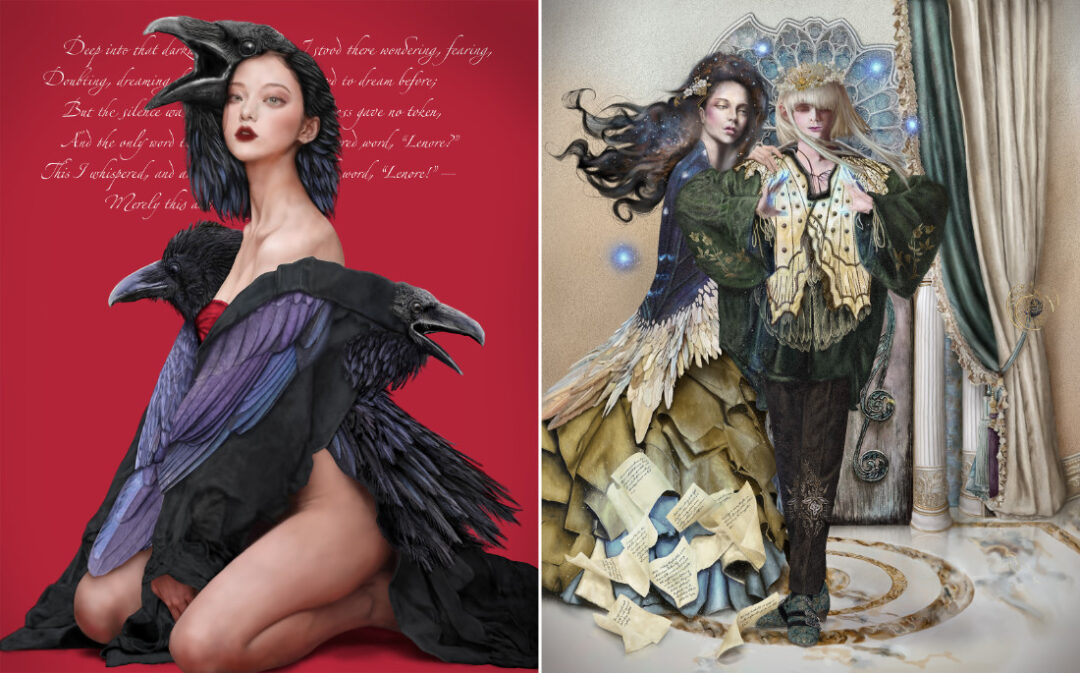
The cultural catalyst for my imaginative realism piece The Lost Lenore is a unique blend of poetry through time: classic gothic and Norse myth and literature underpinned by symbology of ravens. Ravens are an avian presence entwined with the Valkyries, divine maidens whose judgement of the fallen and entanglement with Odin, god of poets and chief of the Æsir, is recounted in Norse myth. Reference to the Valkyries is dappled through Prose Edda, a 13th century mythological text, yet, the maidens’ divine role is perhaps more extensively articulated in Song of Dorrud (Darraðarljod). This mode of the Valkyries is interwoven with Edgar Allan Poe’s classic 1845 gothic poem The Raven, through the narrator’s pinned for lost love, “Lenore.” In The Lost Lenore she is illustrated as a variant Valkyrie, an anthropomorphic representation of the tempestuous raven that visits him.
Looking ahead, what projects are you most excited to explore next?
This month my work, including a custom-framed, wall-ready giclée print of The Lost Lenore, is in show at the main space of Mahtay Café & Lounge, a prime social nucleus in my home city of St. Catharines. A vast collection of my most popular fine art prints, premium art cards, and originals will also be at The Hub & Gallery in Ridgeway, Ontario, tangentially onsite for Fort Erie Arts Council’s Christmas on the Ridge event from December 5th to 6th. My family and I have also been preparing for future Comic Con events, paired with the grand opening in Spring 2026 of an online store with smaller ticket items, underlining our goal for broader international reach.
I have several thrilling collaborations ahead, as well: The first with a highly renowned and much-adored digital portrait painter; our project will potentially pair with an in-depth interview piece at Hyperlux Magazine. Digital Artist Exhibitions is bolstering its online Artist Directory for an official debut on faybelarts.com in early 2026. With 365 Art + Magazine in Japan, I have been selected to work as lead cover artist and guest chief editor of an upcoming specialty issue, Art of the Phoenix: Path to the Inner Self. Submissions for this volume will open to artists and designers of all mediums (excluding generative AI), after my spine is further stabilized with intervention(s) surgically in 2026.
About the artist
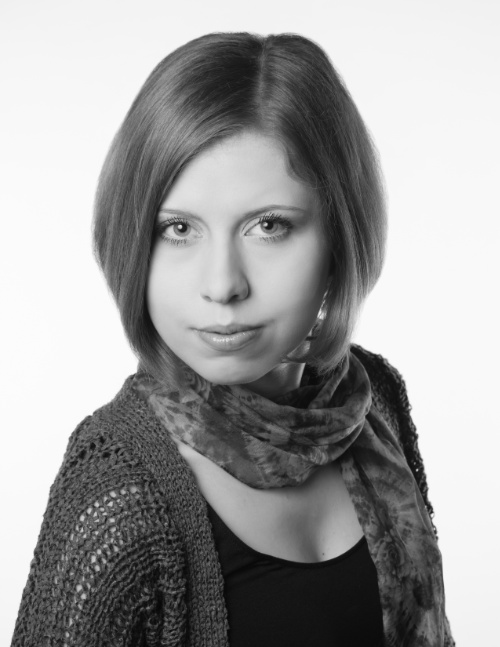
Elaine (Ellie) Nesbitt, known online as FAYBEL, is a self-taught, figurative, fantastical, portrait painter, gallery, and cover artist working in the digital medium. She currently resides in the Great Lakes lowlands of Ontario, Canada.
Learn more about her and her work at her website, or follow her work on Instagram, Facebook, or Threads.